
Background
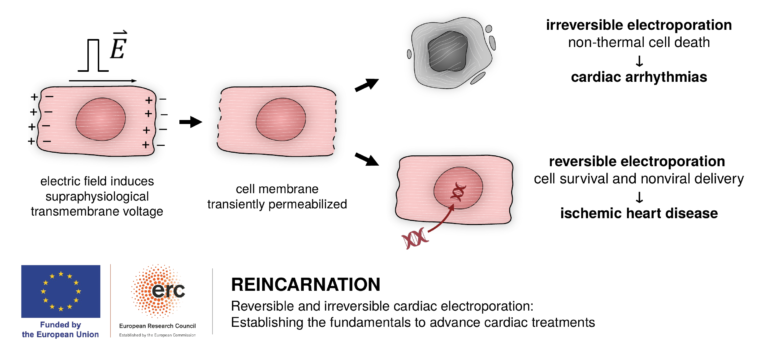
Ischemic heart disease and atrial fibrillation are the most prevalent cardiovascular conditions worldwide. Electroporation, i.e., the application of intense pulsed electric fields, is relevant for the treatment of both. Pulsed field ablation, which relies on irreversible electroporation to ablate arrhythmogenic cardiac tissue, has recently entered clinical practice for treating atrial fibrillation. In parallel, reversible electroporation is being explored as a nonviral method for intracellular delivery of therapeutic nucleic acids that promote cardiac regeneration, which could offer a new approach for treating ischemic heart disease. In this case, the cells need to survive and express the delivered transgenes. Due to the limited fundamental understanding of cardiac electroporation, there are currently no reliable methods to ensure electroporation (ir)reversibility and the desired treatment outcome. For example, the disappearance of local electrograms immediately after pulse delivery does not necessarily indicate cardiomyocyte death.
Aim and objectives
The aim of REINCARNATION is to decipher the biophysical mechanisms of cardiac electroporation at the molecular, cellular and tissue level, and to develop methodologies that will enable optimal implementation of both irreversible and reversible electroporation. We combine bottom-up experiments in primary cardiac cells and myocardial tissue slices with computational modelling and advanced data analysis. The project addresses four objectives:
- To unravel the molecular basis of cardiomyocyte stunning upon electroporation and the possible role of membrane ion channels, by developing a coupled model of cardiomyocyte electrophysiology and electroporation.
- To identify biophysical responses of cardiomyocytes, additional or alternative to the electrogram, that can serve as predictors of reversible or irreversible electroporation, using experiments in vitro combined with machine learning.
- To determine optimal conditions, in terms of pulse parameters and type of nucleic acids (plasmid DNA, microRNA), for using reversible electroporation as a nonviral delivery method in cardiomyocytes and cardiac fibroblasts.
- To implement myocardial tissue slices as a model for electroporation studies that can bridge in vitro and in vivo research, and to relate the results obtained in primary cells to the tissue level through computational modelling.
Expected outcomes
The project will provide mechanistic understanding of how cardiac cells and tissue respond to pulsed electric fields, computational models for predicting cardiac stunning and reversible or irreversible electroporation, and a database of cardiomyocyte responses to different pulse waveforms. Together, these results will create the foundations needed to streamline further (pre)clinical research and support the development of electroporation-based treatments of cardiac arrhythmias and ischemic heart disease.
CORDIS website: https://cordis.europa.eu/project/id/101115323
Project details
| Principal investigator | Lea Rems Mahnič |
|---|---|
| Role | PI |
| Home institution | University of Ljubljana, Faculty of Electrical Engineering, Slovenia |
| Funder | European Research Council (ERC), Horizon Europe – ERC Starting Grant (ERC-2023-STG), grant agreement No. 101115323 |
| Start date | January 2024 |
| End date | December 2028 |
| Grant budget | EUR 1.5M |
| Participant institutions | University of Ljubljana, Faculty of Electrical Engineering, Slovenia |